The History of the UROFA 59: Germany’s First Flyback Pilot Chronograph

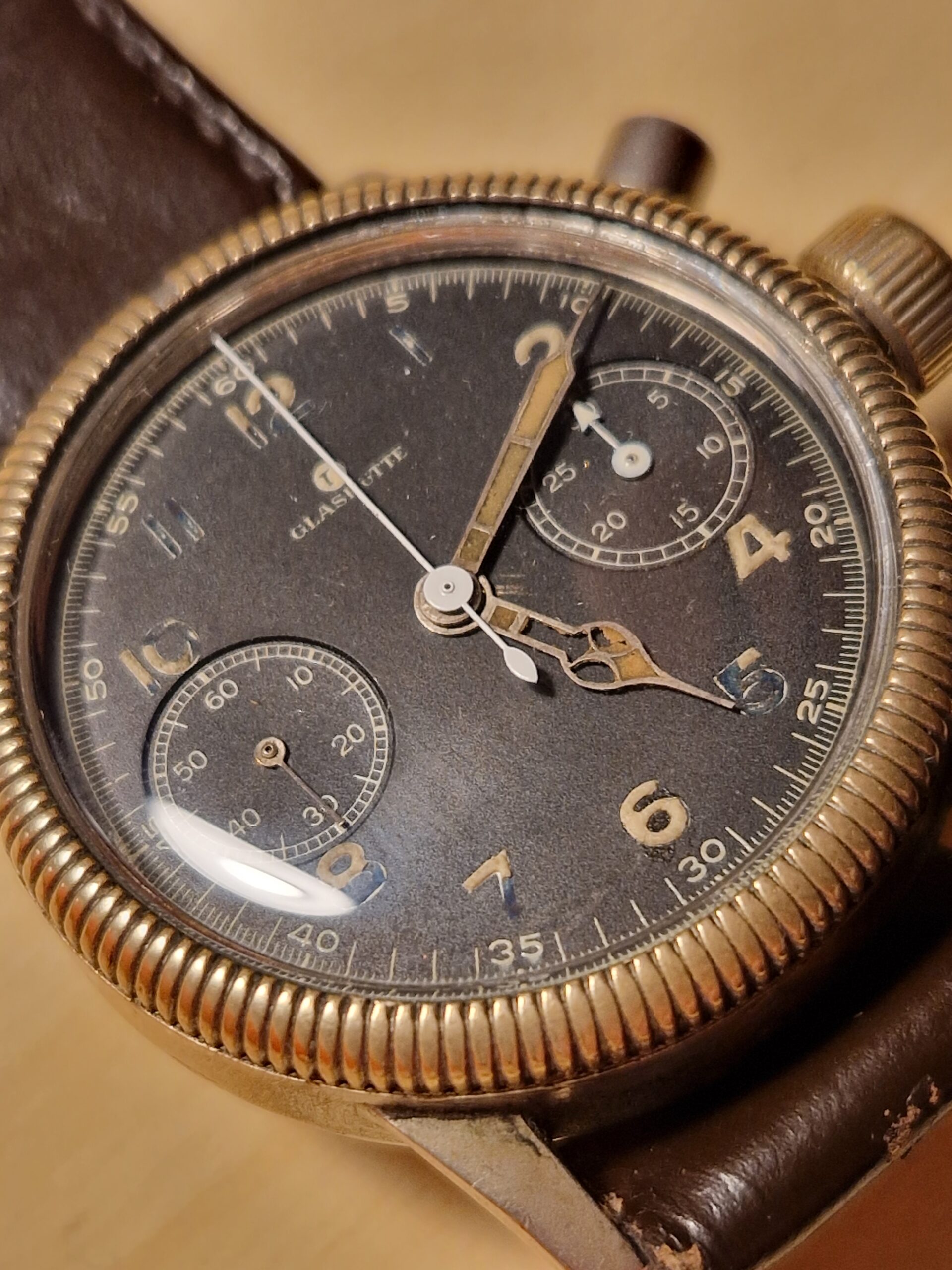
The UROFA 59 is one of the most important German chronograph movements of the twentieth century. It was not created as a luxury calibre or as a decorative complication. It was designed as a serious aviation instrument, built in Glashütte for pilots who needed precise timing in the air.
Its history brings together several worlds: the rebirth of Glashütte wristwatch production, the vision of Dr. Ernst Kurtz, wartime aviation, and the complicated post-war fate of German watchmaking.
Glashütte Before UROFA
After the First World War, Glashütte was in a difficult position. The town had a long tradition of precision watchmaking, but much of its reputation had been built around pocket watches, marine chronometers and high-grade precision instruments.
By the 1920s, the market was changing. Wristwatches were becoming more important, while many older German watch companies were struggling with inflation, economic crisis and competition from Switzerland.
Out of this difficult period came one of the most important figures in modern Glashütte history: Dr. Ernst Kurtz.
Dr. Ernst Kurtz: The Man Behind UROFA and UFAG
Ernst Kurtz was not a traditional watchmaker. He was a trained jurist from Hamburg. That makes his role even more interesting.
In 1926–1927, after the collapse of the Deutsche Präzisions-Uhrenfabrik Glashütte, Kurtz helped reorganise what remained of the local industry. With financial support connected to Saxon banking interests, two new companies were formed.
UROFA — Uhren-Rohwerke-Fabrik Glashütte AG — was created to manufacture movements.
UFAG — Uhrenfabrik Glashütte AG — was created to assemble and sell complete watches.
Kurtz understood something that many older manufacturers had been slow to accept: the future belonged to wristwatches. Under his direction, UROFA and UFAG moved toward more modern production methods and a more industrial approach to movement manufacturing.
This was a major shift for Glashütte. Kurtz did not simply continue the old tradition. He helped redirect it.
The Tutima Name
The best watches produced by UFAG using UROFA movements were sold under the name Tutima.
The word Tutima comes from Latin and is usually translated as “safe” or “secure”. It was chosen to represent reliability and quality.
By the 1930s, Tutima had become the prestige name connected with UROFA and UFAG production. While UROFA made movements and UFAG assembled watches, Tutima became the public face of their best work.
Why a New Pilot Chronograph Was Needed
By the late 1930s, aviation placed new demands on timekeeping.
A pilot’s watch had to be readable, robust and easy to operate. But pilots also needed to measure short intervals for navigation, manoeuvres, fuel calculations and operational timing.
A simple three-hand wristwatch was not enough. A chronograph was needed.
The key feature was the flyback function, known in German as Tempostopp. On a normal chronograph, the user has to stop, reset and restart the timer in three separate actions. A flyback chronograph allows the running chronograph to be reset and restarted immediately with one push.
For aviation, this was not a luxury. It was practical.
The Development of Calibre UROFA 59
In 1938, UROFA was brought into German military production and received the task of developing a wrist chronograph movement for aviation use.
The result was Calibre 59.
The movement was developed around 1939–1941 and was fitted into the Tutima Fliegerchronograph, which entered wartime production in 1941.
The UROFA 59 was a manually wound chronograph movement with a column-wheel system, 17 jewels, a 30-minute counter and flyback function. It ran at 18,000 vibrations per hour.
It is widely regarded as the first German chronograph movement with flyback function.
Technical Character of the UROFA 59
The UROFA 59 was not a small or delicate dress-watch movement. It was a functional instrument calibre.
Known technical features include:
- manual winding;
- 17 jewels;
- column-wheel chronograph control;
- flyback / Tempostopp function;
- 30-minute chronograph register;
- small seconds;
- 18,000 vibrations per hour;
- approximately 34 mm movement diameter;
- shock protection;
- use in large pilot’s chronograph cases.
The movement was designed for usability and reliability rather than decoration. This is one reason collectors value it so highly today. It is a true tool-watch movement from the age before “tool watch” became a marketing term.
The Tutima Fliegerchronograph
The UROFA 59 was used in the Tutima Fliegerchronograph, one of the most famous German aviation chronographs of the Second World War.
The watch usually had a black dial, luminous Arabic numerals, luminous hands, two sub-dials, large chronograph pushers and a rotating bezel with a marker.
The case was around 39 mm, large for the period, but practical for cockpit use. Many examples used nickel-plated or chromed brass cases, although variations exist.
The watch was issued to German military pilots and became one of the defining aviation chronographs of its era.
Production Numbers
The often repeated figure is that around 30,000 Tutima pilot chronographs with UROFA 59 movements were produced between 1941 and 1945.
Exact numbers are difficult to prove today because wartime records were damaged, lost or scattered after 1945. For this reason, the figure should be treated as an informed historical estimate rather than a complete surviving factory record.
Still, the number appears consistently in modern Tutima history and collector literature.
Serial Numbers and Surviving Examples
Serial numbers are one of the most difficult parts of UROFA 59 research.
Known surviving wartime examples often show six-digit movement numbers, with documented examples appearing in the 200,000 range. For example, collector and dealer references include wartime Tutima/UROFA 59 watches with movement numbers such as 204172 and 213490.
However, there is no complete publicly available factory serial-number register for the UROFA 59. Because of that, it is safer to say that surviving examples suggest certain serial ranges rather than claiming a fixed production sequence.
Post-war Soviet-associated examples are different. Many of them show lower serial numbers and may include markings connected with the First Moscow Watch Factory, often written as 1МЧЗ. These watches belong to the later chapter of the UROFA 59 story.
1945: The End of Original Glashütte Production
In May 1945, the war reached Glashütte.
The town and its factories suffered heavy damage. Ernst Kurtz left Glashütte and moved west with some employees. Original UROFA and UFAG production in Glashütte came to an end.
This was the end of the first life of the UROFA 59.
But it was not the end of the movement’s history.
The Soviet Chapter
After the war, Glashütte fell within the Soviet occupation zone. As part of post-war reparations, machinery, tools, unfinished parts and technical documentation from German factories were removed.
The UROFA/UFAG chronograph equipment and knowledge connected with Calibre 59 were taken east. Soviet production later appeared at the First Moscow Watch Factory.
Early Soviet examples appear to have used German parts, German tooling or a combination of German and newly made Soviet components. Later examples were produced with more Moscow-made parts.
These watches are often described by collectors as Soviet UROFA 59 or 1МЧЗ chronographs.
This part of the story should not be treated as the origin of the movement. The UROFA 59 was a German Glashütte design. But the Soviet continuation is historically important because it shows how valuable the design was even after the war.
Very few chronograph movements have such a complex double life: born in Glashütte, used as a German aviation instrument, then continued in Soviet watch production after 1945.
Kurtz After Glashütte
After leaving Glashütte, Ernst Kurtz continued watch production in West Germany. He first worked with remaining Glashütte parts and later developed new production under his own direction.
The post-war Tutima story eventually continued in western Germany before the brand returned to Glashütte many decades later.
Kurtz’s importance is not only that he managed UROFA and UFAG. His larger achievement was that he helped transform Glashütte from an old precision-watch town into a centre capable of producing modern wristwatch movements on an industrial scale.
Without Kurtz, there would likely have been no UROFA 59.
Why the UROFA 59 Matters Today
The UROFA 59 matters because it was created for a real purpose.
It was not designed for collectors. It was not designed for display windows. It was built for pilots.
It represents:
- the rebirth of Glashütte wristwatch production;
- the industrial vision of Dr. Ernst Kurtz;
- one of Germany’s earliest and most important wrist chronograph movements;
- the first German flyback chronograph tradition;
- the Tutima Fliegerchronograph;
- wartime aviation history;
- and the post-war transfer of watchmaking technology into Soviet production.
For collectors today, a UROFA 59 is more than a rare movement. It is a historical document in mechanical form.
It tells the story of Glashütte before 1945, of German engineering under pressure, of aviation timing, of destroyed factories, and of a movement whose life continued far beyond the place where it was born.
That is why the UROFA 59 remains one of the most fascinating military chronograph movements ever made.
Found this article useful?
If this guide helped you identify, date or research your watch, consider supporting future UKCHRONO Journal articles and research.